Under the Control of Substances Hazardous to Health Regulations 2002, most local exhaust ventilation systems must be thoroughly examined and tested at least once every 14 months. A small number of processes need it far more often, in some cases every month. If an inspector asks for your current LEV test report and you cannot produce one, you are in breach.
That is the short answer. The rest of this guide covers what the law actually says, what a thorough examination involves, what your report has to contain, and what it costs.
What is LEV testing?
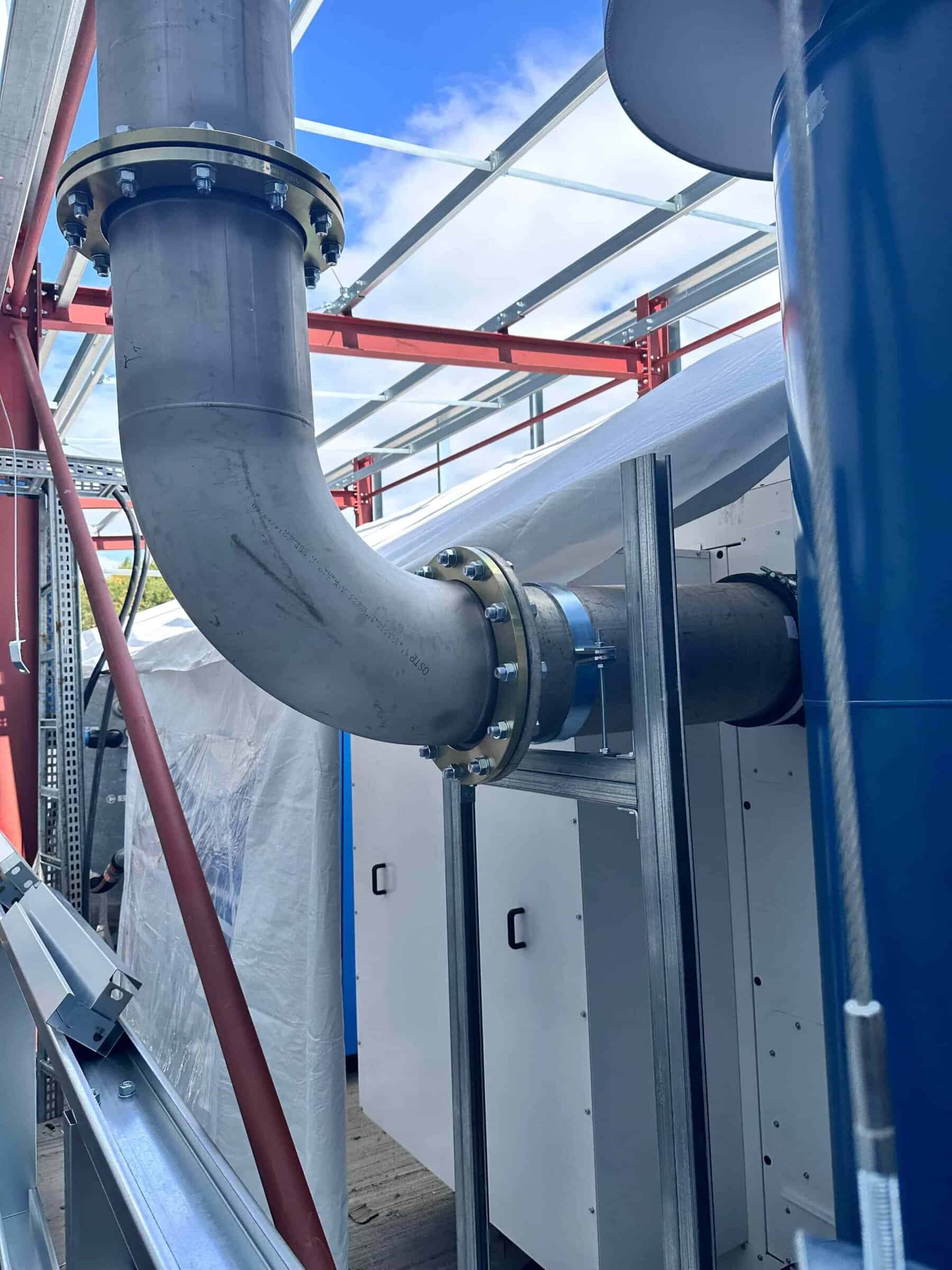
LEV stands for local exhaust ventilation. It is any engineered system that captures dust, fume, mist, vapour or gas at the point it is produced and takes it away from the person working there. Weld fume arms, downdraught benches, spray booths, on-tool extraction and centralised dust extraction plant are all LEV.
LEV testing, properly called a thorough examination and test, is the statutory check that the system still does the job it was designed to do. It is not a service visit and it is not the same thing as a maintenance contract. A service keeps the equipment running. A thorough examination and test proves the equipment is still controlling exposure to a level that protects the people using it.
That distinction matters, because a system can be running perfectly and still fail its test.
How often does LEV testing need to be done?
The 14 month rule
For most systems, the interval is at least once every 14 months. This comes from COSHH Regulation 9, and the 14 month figure exists for a practical reason: it lets an annual testing programme drift slightly without falling out of compliance. It is a maximum, not a target. If your system is heavily used, poorly maintained or controlling something particularly hazardous, testing more often is the sensible choice.
One point that catches people out. The clock runs from the date of the last test, not from the start of your financial year or the date you signed a contract. If your last report is dated 3 March, your next test is due by 3 May the following year at the latest.
Processes that must be tested more often
COSHH Schedule 4 sets shorter intervals for four specific processes. If your work falls into any of these, the 14 month rule does not apply to you:
| Process | Maximum interval |
| Blasting carried out in, or incidental to, the cleaning of metal castings in connection with their manufacture | 1 month |
| Jute cloth manufacture | 1 month |
| Processes, other than wet processes, in which metal articles other than gold, platinum or iridium are ground, abraded or polished using mechanical power, in any room for more than 12 hours a week | 6 months |
| Processes giving off dust or fume in which non-ferrous metal castings are produced | 6 months |
The third entry is the one most commonly missed. A fabrication shop running grinding or polishing benches for more than 12 hours a week is on a six month cycle, not an annual one, and a lot of workshops are on an annual cycle without realising they should not be.
What COSHH Regulation 9 actually requires
Regulation 9 is short, and it asks for three things rather than one. Meeting only the testing requirement is a common way to fail an inspection while holding a valid certificate.
- Keep the system in efficient working order, in good repair and in a clean condition. This is a continuous duty, not something that applies on test day.
- Have the system thoroughly examined and tested at the required interval by someone competent to do it.
- Keep a suitable record of every examination and test for at least five years, and make it available.
The five year record requirement is worth reading twice. Inspectors frequently ask for the history rather than the current certificate, because a run of reports showing the same fault recurring year after year tells them something a single clean report does not.
On competence: there is no statutory licence, but the recognised route is the BOHS P601 qualification in thorough examination and testing of LEV systems. It is reasonable to ask any prospective tester to show you their P601 certificate before you appoint them.
What happens during a thorough examination and test
A proper examination has three stages. If a visit only covers the third one, you have bought an airflow reading rather than a thorough examination.
Stage one: what is the system supposed to do?
The examiner establishes what the system was designed to control and to what standard. That means looking at the commissioning data, the LEV user manual and the logbook. Where none of that exists, which is common on older plant, the examiner has to establish a benchmark from first principles before anything can be judged against it.
Stage two: what condition is it in?
A physical inspection of every element: hoods, ducting, dampers, the air cleaner or filter, the fan, and the discharge point. The examiner is looking for damage, wear, blockage, corrosion, incorrect damper settings and modifications nobody recorded. Hood position and condition matter most, because a hood in the wrong place cannot control exposure however well the fan is performing.
Stage three: is it performing?
Measurement. Face and capture velocities at each hood, static pressures across the system, filter condition, and where appropriate a qualitative check using smoke or dust lamp techniques to see where the contaminant actually goes. The results are compared against the benchmark from stage one.
The examiner then reaches a conclusion that matters more than any individual number: does this system adequately control exposure, or does it not?
What your LEV test report must contain
A single page certificate with a pass stamp is not a thorough examination report and will not satisfy an inspector. Your report should include:
- Your details as the employer, and the address of the installation
- A description of the process and the substances being controlled
- A description of the LEV system, ideally with a schematic and numbered extraction points
- The benchmark or commissioning performance the system is being measured against
- The methods used, the instruments used, and the measurements taken at each point
- Every fault found, with the remedial action needed and a sensible timescale for it
- A clear statement of whether the system adequately controls exposure
- The name, signature, qualification and date from the person who carried out the work
If your current report is missing the benchmark data or the remedial actions, that is worth raising with whoever produced it.
What you need to do between tests
Fourteen months is a long time for a system to go unchecked, and the duty to keep it in efficient working order applies every day in between. Three things make the difference:
- Airflow indicators on every system, so an operator can see at a glance whether extraction is working. A simple gauge or manometer is enough. Without one, nobody notices a gradual decline until the annual test.
- Short operator checks, recorded. A weekly visual check of hoods, ducting and the airflow indicator, written down, demonstrates the continuous duty is being met.
- An up to date logbook. Every repair, modification and filter change recorded. This is also what makes the next thorough examination quicker and cheaper.
Operator technique is the other half of it. A well designed extracted bench controls nothing if the work is being done outside the capture zone, and that is a training issue rather than an engineering one.
What happens if you cannot produce a current test report
Failing to test is a material breach of health and safety law. Where an HSE inspector identifies a material breach, the Fee for Intervention scheme applies, and the cost is recovered at an hourly rate covering the time taken to identify the problem and see it put right. From 1 April 2026 that rate is 188 pounds an hour, charged from the moment the inspector arrives through to the point the case is closed.
The rate is only part of it. The hours accumulate across the investigation, the follow up and the associated office work, and in serious cases an improvement notice or prohibition notice can stop the process entirely until the system is brought up to standard. For a production line, the cost of the stoppage will usually dwarf the fee.
There is also the longer term exposure. LEV exists to prevent occupational disease, and occupational disease claims can arrive many years after the exposure that caused them. A five year record showing the system was properly examined and maintained is a defence. An absence of records is not.
What does LEV testing cost?
Anyone quoting a single price without seeing the system is guessing. The cost is driven by a handful of things, and understanding them puts you in a much better position when you compare quotes:
The number of extraction points. This is the biggest factor by far. Testing is priced per hood or per point far more than per system.
- System complexity. A single hood on a dedicated fan is straightforward. A branched centralised system with dampers and multiple drops takes considerably longer.
- Whether drawings and commissioning data exist. If they do not, the examiner has to establish a benchmark from scratch, and that adds time to the first visit. It is a one off cost, not a recurring one.
- Site access and downtime. Systems that can only be tested during a shutdown or outside production hours cost more to test.
- Location and travel.
A useful comparison question when you get quotes: ask how many extraction points the price covers and what happens if the examiner finds more on the day. That single question separates the thorough quotes from the optimistic ones.
Frequently asked questions
Is LEV testing a legal requirement?
Yes. COSHH Regulation 9 requires a thorough examination and test at least every 14 months for most systems, with shorter intervals for the processes listed in Schedule 4.
Who can carry out LEV testing?
A competent person. There is no statutory licence, but the BOHS P601 qualification is the recognised standard and it is reasonable to ask to see it.
How long does an LEV test take?
It depends almost entirely on the number of extraction points. A single hood might take under an hour. A centralised system serving twenty points across a factory can take a full day or more.
What is the difference between LEV testing and LEV servicing?
Servicing keeps the equipment running. A thorough examination and test proves it is still controlling exposure. You need both, and a service visit does not discharge your duty under Regulation 9.
How long do I need to keep LEV test records?
At least five years. Inspectors often ask for the history rather than just the current report.
What happens if my LEV system fails its test?
The report will set out the faults and the remedial work needed. Failing a test is not itself an offence. Knowing about a fault and leaving it unaddressed is a different matter.
Who carries out your testing matters
Norvent has carried out remedial and project works on fume extract systems for Public Health England, and works with manufacturers including JLR, BMW, Bentley and Aston Martin. The advantage of using a contractor who also designs and installs LEV is that a failed test does not become a second procurement exercise. The people who found the fault can price and carry out the fix.
Book a free LEV assessment
Norvent designs, installs, tests and repairs local exhaust ventilation systems across industrial and commercial sites nationwide. If you are not sure whether your systems are compliant, or your last report raised faults nobody has dealt with, we will come and look at them at no cost.
- A free site assessment of your existing LEV systems
- Thorough examination and testing to COSHH Regulation 9
- Remedial work, modifications and full system replacement
- Ongoing servicing so you are not scrambling before the next test
Call 01527 835050, email info@norvent.co.uk, or request your free assessment online.